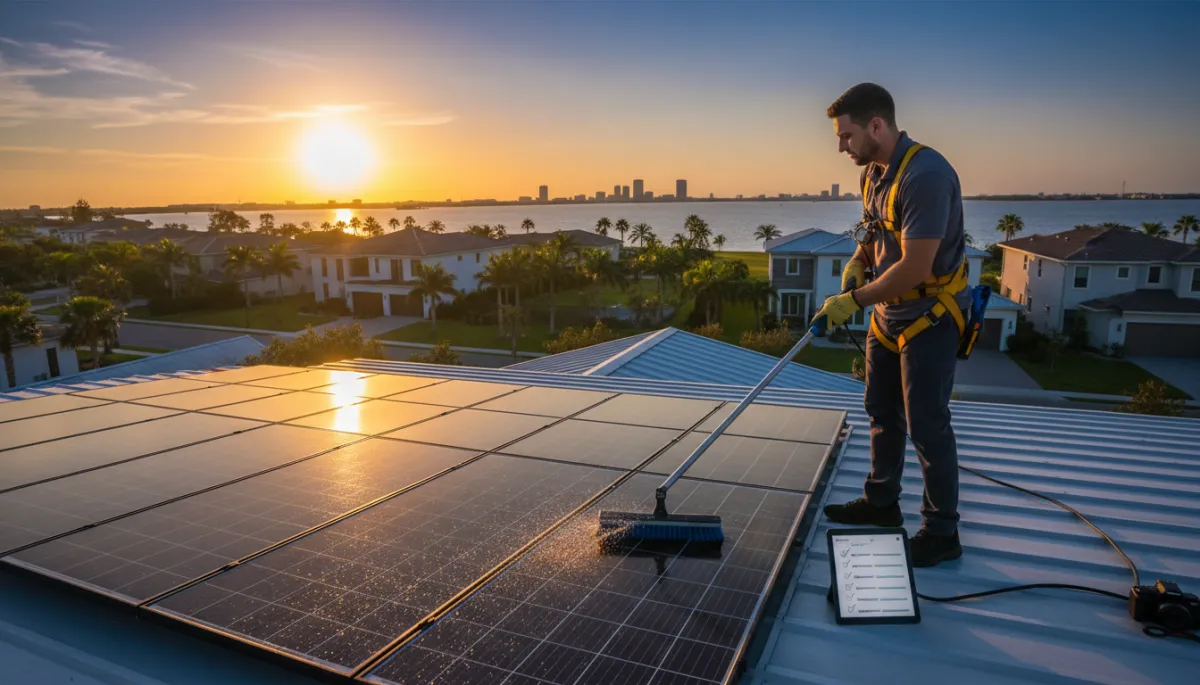
How to Choose a Solar Maintenance Company in Tampa Bay
Solar Maintenance, Tampa Bay Homeowners
How to Choose a Solar Maintenance Company in Tampa Bay
When you start calling around for solar cleaning and inspection in Tampa Bay, it is common to receive quotes that are far apart in price but vague on details. The most useful thing you can do is slow down, ask the same set of questions to every company, and compare the answers in writing. Fused Solar and Roofing is a licensed roofing (CCC1331058), electrical (EC13014750), and building contractor (CBC1252064) — all three in-house.
1. Ask what work the visit actually includes, and get it in writing
Start by asking, “Exactly what does this visit include, and what does it not include?” A clear answer for a maintenance visit should specify that the technician will visually inspect the solar array, roof area around the array, and exposed electrical components; clean the accessible solar modules using appropriate methods; and document the condition with photographs and written notes. For a Tampa Bay homeowner, that typically means checking for cracked modules, obvious wiring issues, loose conduit straps, and visible roof concerns around the mounting points, then washing away typical coastal and subtropical soiling such as pollen, dust, and bird droppings. A good contractor will also state, in writing, that any corrective work is quoted separately and only performed with your approval, rather than adjusted on the spot without discussion.
2. Ask which licenses the company holds, and verify them yourself
In Florida, panel cleaning by itself does not require a contractor’s license. However, once work involves the roof covering, the contractor should hold an appropriate roofing license, and once work involves wiring, terminations, inverters, or connections to the service panel, the contractor should hold an electrical license. Ask, “Which Florida licenses does your company hold, and under what company name?” A strong answer lists the license types and numbers and matches them to the business name you are hiring. You can then use the state’s public license search to look up any license number, confirm that it is active, and confirm that it matches the company name on your proposal and invoice. This tells you which categories of work a given company is licensed to perform, and which would have to go to someone else.
3. Ask who is responsible if something on the roof is damaged
Any time someone is walking your roof, you are entitled to a clear answer on responsibility. Ask, “If a tile, shingle, or piece of equipment is damaged during the visit, how is that handled?” A professional response explains that the technician documents existing conditions with photos before work starts, reports anything pre-existing, and gives you a clear process for handling damage caused during the visit. For a licensed roofing contractor, that typically includes assessing the roof covering itself and specifying how any needed repair would be quoted as separate roofing work. You are not looking for dramatic promises—just a straightforward process that starts with documentation, continues with clear communication, and ends with a written proposal before any repair proceeds.
4. Ask what happens when they find a problem
A good maintenance visit separates inspection from repair. Ask, “If you find a problem, what happens next?” A clear answer sounds like this: the technician documents the issue with photographs, notes the location and apparent cause, and includes that information in the written report. You then receive a separate, itemized proposal if corrective work is recommended. During a Fused Solar and Roofing visit, the technician inspects, cleans, and documents; they do not tighten, torque, adjust, repair, replace, troubleshoot, or correct anything during that maintenance appointment. Corrective work is scheduled only if you approve it after reviewing the written findings and any proposed scope. This approach keeps the inspection objective and gives you time to make informed decisions, especially when roof or electrical work is involved.
5. Ask what documentation you receive afterward
Documentation is where the value of a maintenance visit often shows up. Ask, “What do I receive after the visit, and when?” For a Tampa Bay homeowner, a strong answer is that you receive a written report containing photographs taken during the visit, along with the technician’s written notes on what those photographs show—such as visible module soiling, debris accumulation, sealant condition at roof penetrations, or visible corrosion on exposed hardware. The report should also summarize any issues that may warrant follow-up, with clear language a non-technical homeowner can understand. This type of documentation is useful for your own records and for discussions with manufacturers or insurers, because it shows the condition of the system and roof at a specific point in time.
Ready to protect your solar investment? See plan options and pricing at https://tampasolarmaintenance.com
6. Ask how the price is set and what could change it
Pricing is one of the biggest sources of confusion. Ask every contractor, “What is this price based on, and what could change it?” Some companies price by roof pitch, stories, or travel distance; others use panel count. Fused Solar and Roofing sets its plan price by panel count and by nothing else, which makes it straightforward to confirm the cost before anyone comes to your home. When you talk with any provider, ask whether the quoted price could change after the technician sees the roof, and under what specific circumstances. A professional answer will spell out those conditions—such as discovering additional arrays that were not listed—and will commit to discussing any change with you before work proceeds, instead of surprising you on the invoice.
7. Ask about insurance and who is on your roof
In addition to licensing, you should know who is physically on your roof and how they are covered. Ask, “Can you provide a certificate of insurance, and are the people on my roof covered under that policy?” A strong answer is that the company can provide a current certificate of insurance on request and that employees and, if applicable, subcontractors working on your roof are covered. It is also reasonable to ask whether the technician is an employee or a subcontractor, how they are trained for roof access, and how long the company has been performing solar maintenance in the Tampa Bay climate. These questions help you understand the team’s familiarity with local weather patterns—such as heavy summer rains, coastal winds, and pollen seasons—that influence soiling and long-term roof performance.
8. What a clear, written answer to all seven looks like
When you put all of this together, you are looking for a concise, written scope that you can keep on file. A well-structured proposal will state that the visit includes inspection, cleaning, and documentation only; list the licenses the company holds and the exact company name on those licenses; explain responsibility for any damage that occurs during the visit; describe how issues are documented and quoted separately; specify the contents of the post-visit report; define how pricing is calculated and under what conditions it could change; and confirm that a certificate of insurance is available and that the people on your roof are covered. Fused Solar and Roofing is a licensed roofing (CCC1331058), electrical (EC13014750), and building contractor (CBC1252064) — all three in-house. Fused Solar and Roofing is an EnergySage Elite Installer with a 5.0/5 rating and 21+ verified reviews — independent verification, earned not purchased. For many homeowners, the final check is membership benefits; in this case, those include priority scheduling within 48 hours where appointment capacity allows, and 20 percent off additional service work and diagnostic visits. For warranty discussions, documented maintenance from a certified installer removes the grounds a manufacturer most commonly uses to deny a claim, and gives you dated photographs of the system’s condition to submit alongside it.
9. FAQ: Tampa Bay solar maintenance questions
1. How do I check a contractor's license in Florida?
You can use the state licensing department’s public search tool to look up a contractor by license number or company name. For each license, confirm that the status is active, the expiration date is current, and the company name matches the one on your proposal and invoice. This applies to roofing, electrical, building, and other construction licenses used for solar maintenance work in Tampa Bay.
2. Does panel cleaning require a license?
Panel cleaning by itself does not require a contractor’s license in Florida. However, once work goes beyond cleaning—such as repairing roof coverings around the array or working on wiring, terminations, inverters, or connections to the service panel—appropriate roofing or electrical licensing is required. Many Tampa Bay homeowners prefer to use a company that can clean, inspect, and, when needed, separately quote licensed roofing and electrical work under the same umbrella.
3. Why do quotes for solar cleaning vary so much?
Quotes vary because companies base pricing on different factors—panel count, roof height, travel distance, or whether a full inspection and documentation package is included. Two quotes can also describe very different amounts of work: one may cover a wash only, another a structured inspection with a written report. Asking exactly what is included, how the price is set, and what could change it helps you compare proposals on equal terms.
4. What should I ask about insurance?
Ask for a current certificate of insurance and confirmation that the people on your roof are covered under that policy. It is also reasonable to ask whether the technician is an employee or subcontractor and how they are trained for roof and ladder safety. In the Tampa Bay area, where roofs can be steep, tall, or slippery after afternoon storms, you want to know the company has established procedures for safe access and coverage if an incident occurs during the visit.
5. Should I use the company that installed my system?
Using your original installer can be convenient, especially if they know your roof layout and equipment. However, it is not required. For maintenance, focus on whether the company is actively servicing systems in Tampa Bay, holds appropriate roofing and electrical licenses for any work beyond cleaning, and provides clear documentation after each visit. If another contractor meets those standards and offers a transparent plan, it is reasonable to use them for ongoing maintenance.
6. What if my original installer is no longer in business?
If your original installer is gone, your system can still be maintained and serviced. Fused Solar and Roofing services all brands and can take over maintenance regardless of who installed the system. The technician will inspect, clean, and document the current condition, then outline any recommended follow-up work in writing. In Tampa Bay’s climate, where normal soiling usually causes only a few percent of annual production loss but localized issues from bird droppings, tree sap, or heavy pollen can be more pronounced, having a new maintenance partner helps keep your system performing consistently over time.
Fused Solar and Roofing offers annual solar maintenance plans across Hillsborough, Pinellas, Pasco, and Manatee counties: $495 per year for 1–25 panels, $595 per year for 26–45 panels, and $695 per year for 46–65 panels. Systems over 65 panels are quoted individually. Request your plan quote at https://tampasolarmaintenance.com
Conclusion: Turn questions into a clear written plan
Choosing a solar maintenance company in Tampa Bay is less about finding the lowest number and more about understanding what stands behind that number. When you ask each contractor the same seven questions—about scope, licensing, responsibility, findings, documentation, pricing, and insurance—and insist on clear written answers, the right choice becomes much easier to see. A structured visit that focuses on inspection, cleaning, and documentation, backed by appropriate roofing and electrical licensing where needed, positions your system for consistent performance in Florida’s demanding climate and gives you a reliable record of its condition year after year.
Is your solar system performing at its best? Request your maintenance plan quote at https://tampasolarmaintenance.com
